Case · Own product · Live at zonrooster.nl
ZonroosterWhat does the end of net metering cost you?
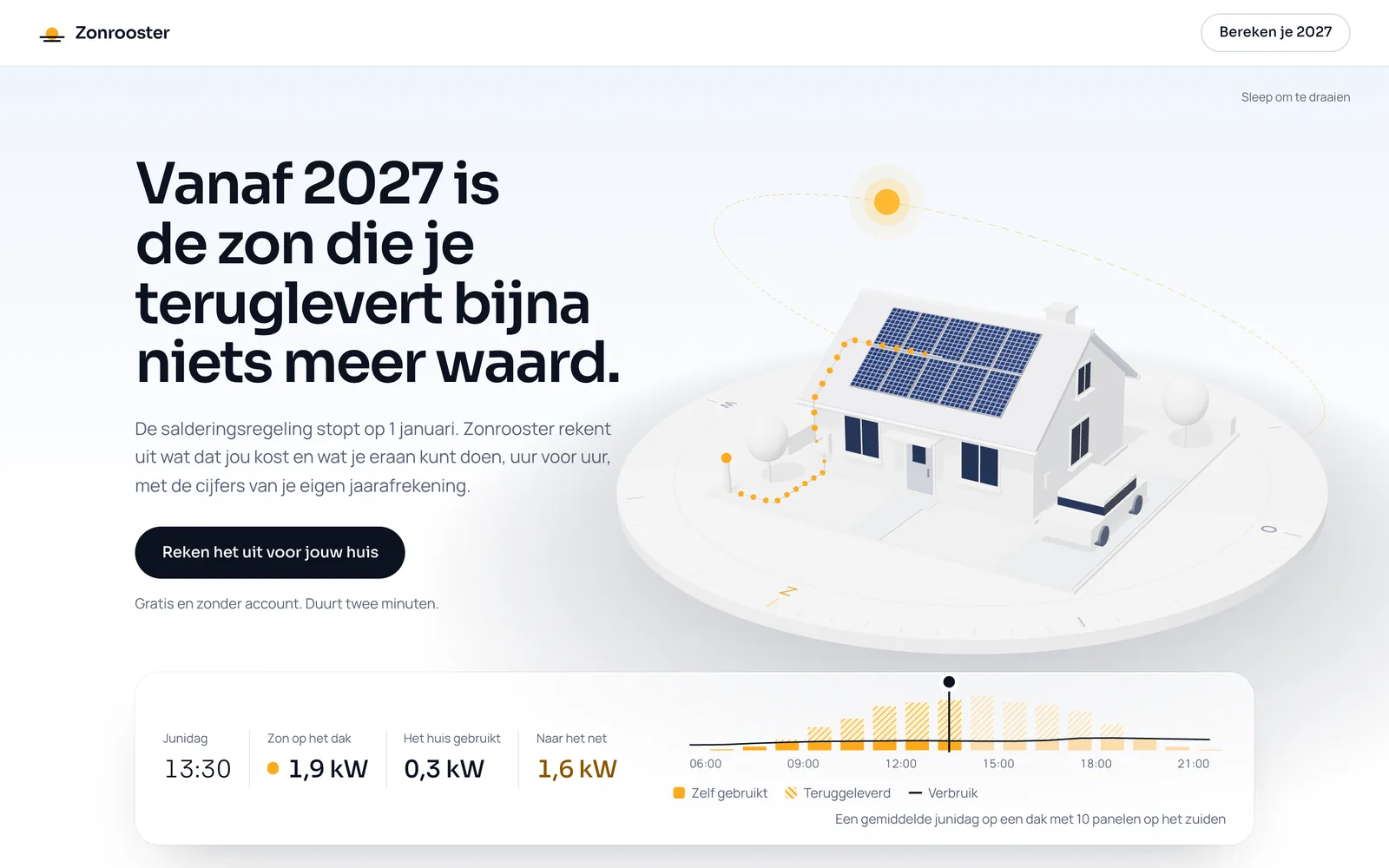
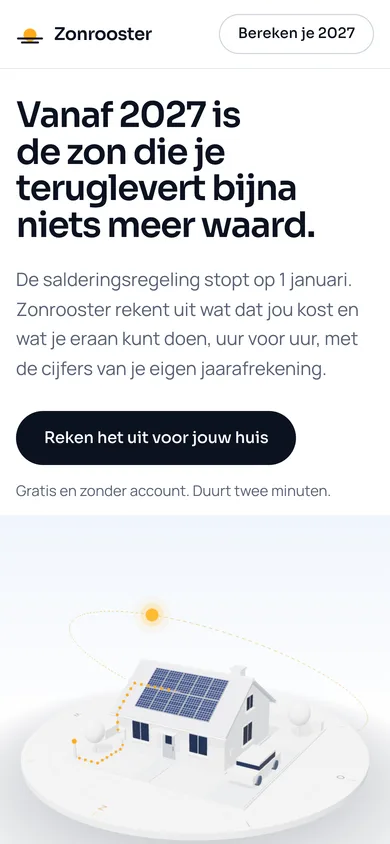
On 1 January 2027 net metering ends in the Netherlands. Zonrooster replays a full year of your home, hour by hour, using the figures on your own annual energy bill. You see what 2027 costs you and what a battery, another contract or smarter use would save.
- 8,760
- Hours a year simulated, per home
- 1 Jan 2027
- Net metering ends in one go
- 2 min
- From energy bill to result
- €0
- Free, no account
From calculation model to 3D house.
Zonrooster is my second own product. I researched the rates and rules, wrote the calculation model and built the site, from the 3D house to the emails. I use the same approach for calculators and dashboards for clients.
- Problem
- Net metering in the Netherlands ends on 1 January 2027, and hardly anyone knows what that means for their own home.
- Solution
- A calculator that replays a full year of the home from the visitor’s energy bill, with solar data per postcode and an interactive 3D house.
- My role
- Everything: rate research, calculation model, design, 3D, backend, email and hosting.
- Result
- Live at zonrooster.nl, in time for the end of net metering.
Technology: Next.js, TypeScript, three.js, React Three Fiber, PostgreSQL, PVGIS
The problem
Until 2027, Dutch households offset the power they feed back against what they use.
From 2027, every hour counts.
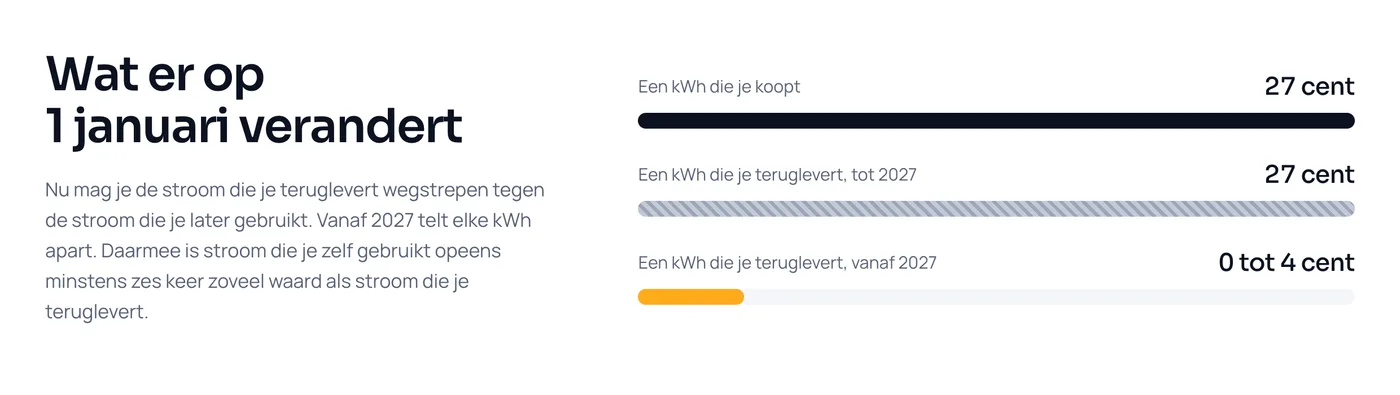
Power you use yourself becomes at least six times as valuable as power you feed back. What that means for a home depends on the roof, the consumption and the contract. An average says little about that, so Zonrooster uses your own figures.
How it works
01 · Explain
First, understand what changes.
Three bars show what a kWh costs and what it earns, before and after 1 January. The amounts come from the same rate table as the calculation model.
02 · Calculate
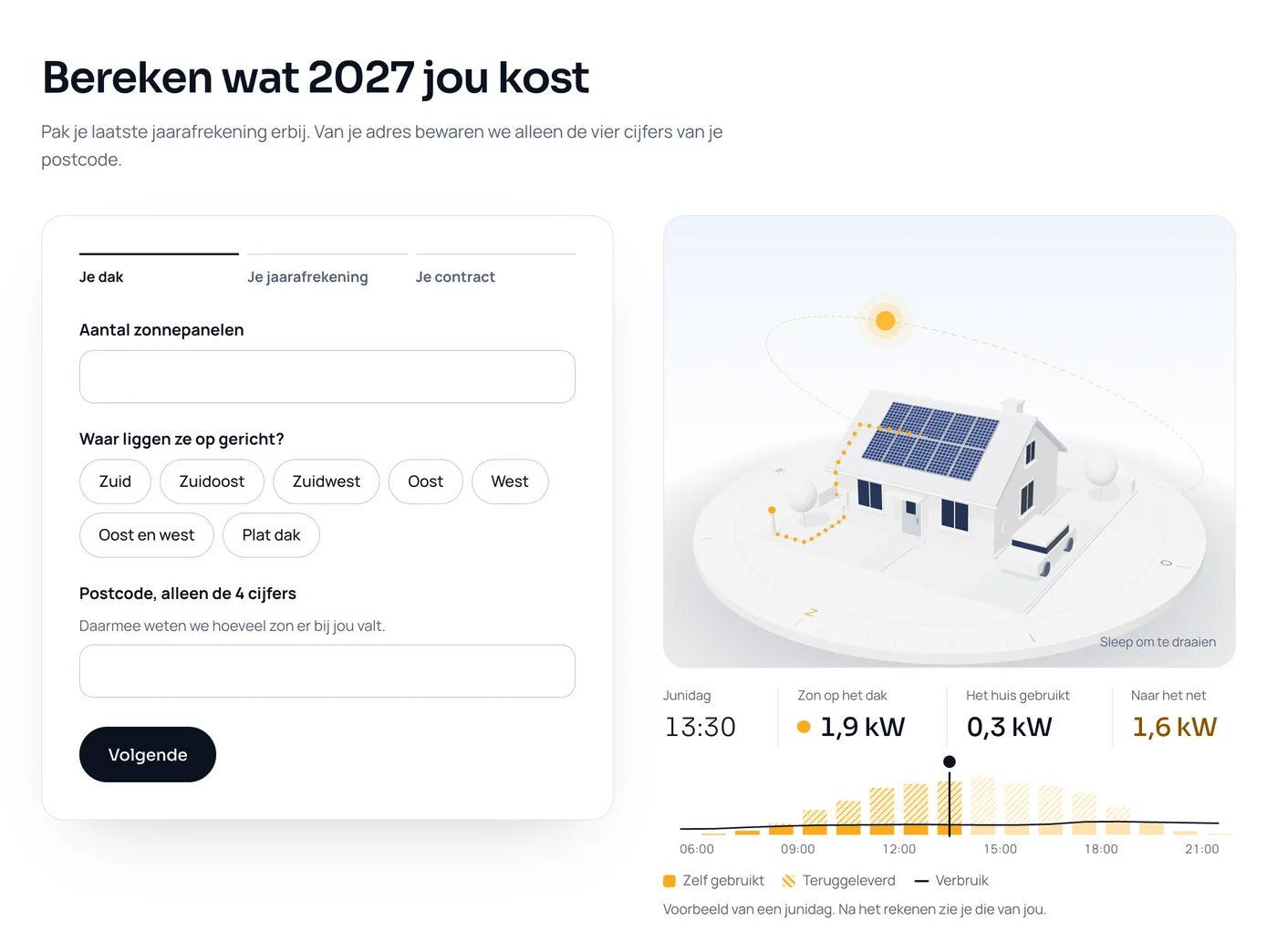
Three steps, with your energy bill at hand.
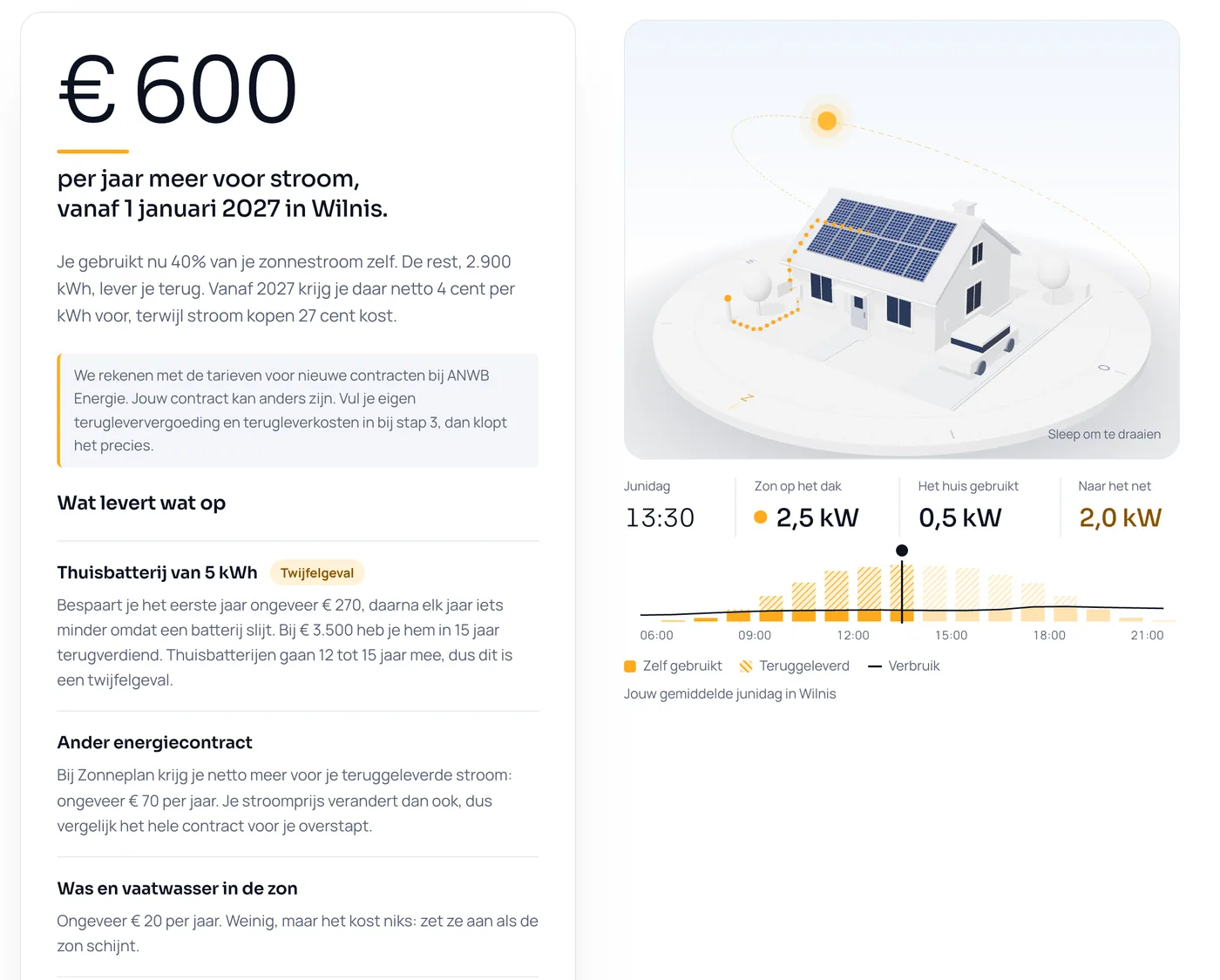
Number of panels and roof direction, your kWh from and to the grid, and your supplier. Meanwhile the house turns along and the chart shows a day on your roof.
03 · Result
What 2027 costs and what to do about it.
The extra cost for your home and what each step saves: a home battery, another contract, running the washing machine in the sun. If a battery does not pay for itself, the result says so. The example is a home in Wilnis with 12 south-facing panels.
Independent
Why visitors can trust the result
Result first
Zonrooster does not sell batteries, panels or contracts. The result is fixed before any provider comes into view.
Hour by hour
No rule of thumb, but a full year replayed with the Dutch consumption pattern and the sun at your location.
Open sources
PVGIS by the EU for the sun, MFFBAS for consumption and the published rates of suppliers.
What Voscey built
Calculation model
A simulation of 8,760 hours: generation, use, feed-in and a home battery, including battery wear. Covered by automated tests.
3D house
An interactive house in three.js with the sun moving over it hour by hour. It loads once the page is ready, so the site stays fast.
Solar data per postcode
Yield per roof direction comes from PVGIS by the EU Joint Research Centre, based on the four digits of the postcode.
Dutch consumption
The official Dutch household load profile (MFFBAS E1A 2027), scaled to the visitor’s annual bill.
Rates
Feed-in payments and feed-in charges of Dutch energy suppliers, with a page per supplier.
Email and privacy
Results by email with confirmation and unsubscribe, only the four postcode digits stored, rate limiting and cookieless analytics.
What’s next
An app for every day.
After the calculator comes an app that reads your smart meter and tells you when to use your own sun. It is planned for spring 2027, when there is enough sun again to notice the difference.
Shall we talk it through?
Briefly describe what you need. You will receive a response within 24 hours on weekdays.